Is Your Beki Lingo Still in the 90s? (A Guide to Not Being a Dinosaur)
A friend once told me that the way I deliver punchlines is actually quite funny. She even went as far as saying she thinks I’m smart because I can come up with something witty to say at the drop of a hat. I laughed and told her, "Honestly, sis, that’s just what happens when you grow up surrounded by the LGBTQ+ community!"
From my childhood in the streets of Pasig (Philippines) to my life now in Canada, my circle has always been full of fabulous gay friends. But here’s the thing, being their friend is a full-time job. You have to stay updated with the lingo, otherwise, you literally cannot keep up with the conversation. If you blink, the dictionary has changed, and you’re left standing there like a confused tourist.
A couple of years ago, I wrote about the fascinating world of Bekenese. Back then, we were all obsessed with how every Juan and Nena was starting to use this creative "code." But honey, it’s 2026, and the "gay-cabulary" hasn’t just grown; it has undergone a full-on cellular mutation.
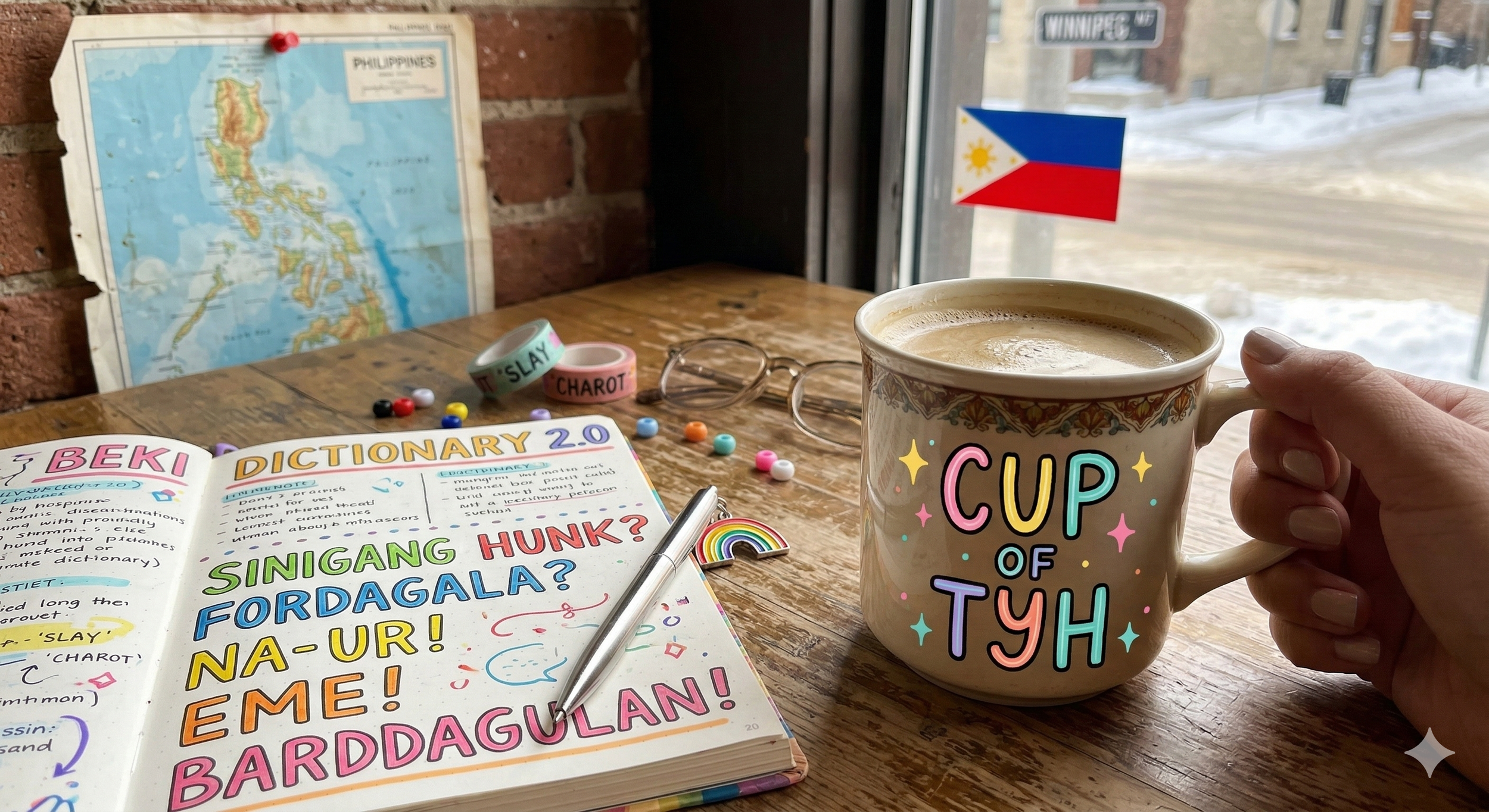
If you thought you were knowslift because you knew Luz Valdez meant losing, I have news for you: Beki Lingo 2.0 is no longer just about rhyming; it’s about layering, irony, and the gloriously absurd.
The most hilarious part of modern Beki Lingo is how one-word travels through multiple "generations" of meaning until the original root is almost unrecognizable.
Take the evolution of being hungry:
Gutom (The Tagalog Root)
Tom Jones (The 90s/2000s Classic)
Thomasites (The historical twist—referring to the American teachers)
Tommy Esguerra (The modern celebrity update)
By the time someone says, "Wititit pwedeng mag-wait, Tommy Esguerra na ang lola mo!" they aren't just saying they’re hungry, they’re performing a three-decade linguistic gymnastics routine. If you can’t keep up with the layers, you’re officially Luzviminda (a very big loser).
If the OG Beki lingo was born in the salons of the 90s, the 2.0 version was raised in the trenches of TikTok. This is where the language went from "slang" to a full-on lifestyle.
Have you noticed how everyone is suddenly a "ferson"? We aren't just people anymore; we are “Forda gala ang ferson” or “Forda breakdown ang ferson.” TikTok took the Beki habit of adding unnecessary suffixes and turned it into a rhythmic art form. Then came the "Eme"…it is the Gen Z successor to Charot. It’s the ultimate "just kidding" safety net you throw at the end of a sentence when you’ve said something a bit too spicy.
And let’s not forget the Bardagulan era. What used to be a simple tarayan (bickering) is now a full-blown sport. If you aren’t "bardagulan ready" in the comments section, shuta, are you even online?
The "New Age" Bekinese Dictionary (2026 Edition)
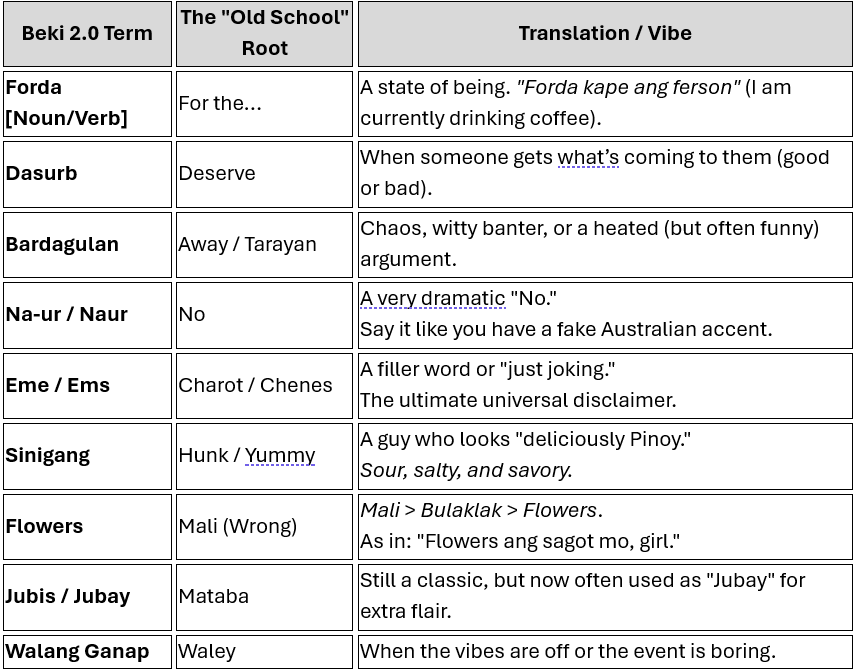
In my last article about Beki Lingo, I gave you a cheat sheet, so, of course, I have an updated one. Keep this cheat sheet under your pillow so you don't look like a total dinosaur when you go out with the Gen Z cousins and friends.
Don’t be a “Dinosaur,” dear. At the end of the day, Beki Lingo is about vibes. It’s about taking a boring Monday and turning it into a “Forda rampa ang ferson” moment. It’s a language that refuses to take life too seriously, proving that Filipinos will always find a way to make life a little more colorful, one eme at a time.
So, don't be afraid to drop a "Sinigang na sinigang ang ferson!" the next time you see a cute guy at the mall. Worst case scenario? They will not get it. Best case? You’ve just made a new bestie who speaks the same glorious, absurd language as you.
Stay slay, stay witty, and never let your gay-cabulary go stagnant!
But wait… there’s more, before you go back to your daily rampa, I want to hear from you.
What is one Beki word that you are STILL using from the 90s/2000s even if it makes you look like a dinosaur?
Are you still a "Tom Jones" loyalist, or have you fully transitioned to "Tommy Esguerra"? Or maybe you have a brand-new term that your circle in Canada or the Philippines just invented?
Drop your favorite gay-cabulary word in the comments below and let's see who has the most pakak vocabulary! Don't be a Luzviminda, join the conversation!
Cristina
The “Tyh” Receipts:
TikTok Philippines: The primary source for the "Forda" and "Eme" era. Viral creators and the "Bardagulan" comment sections act as the modern-day laboratory for new terms.
Twitter (X) Philippines: Historically the birthplace of many celebrity-name puns and the evolution of the "Marites" family tree.
Reyes, J. J. (1970s). The Origin of Swardspeak.
Academic Studies on Beki Lingo, University of the Philippines (Diliman)